
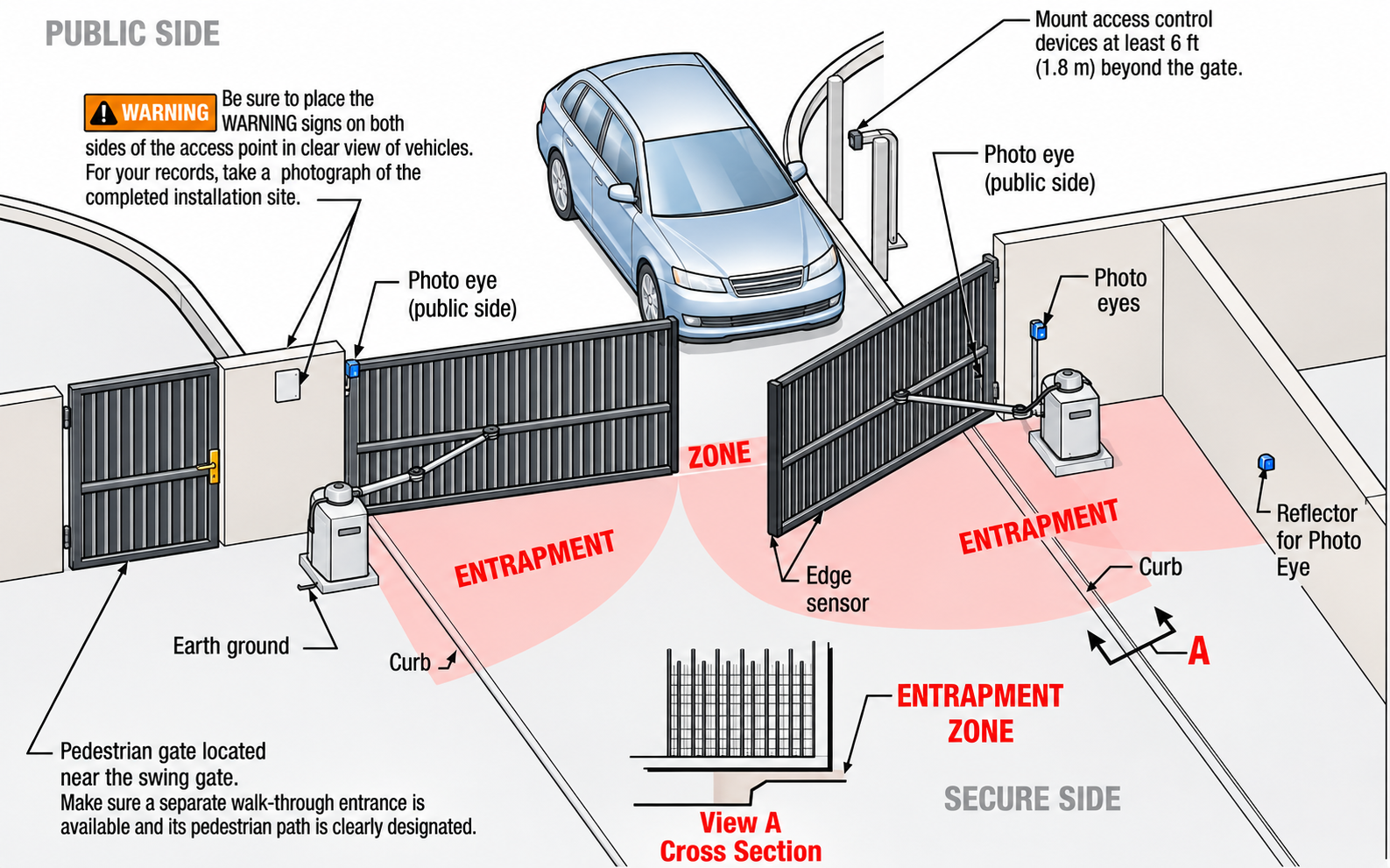

Plan the gate and site layout
- Swing Arc and Run-Back Space. For swing gates, verify that the driveway grade clears the gate through its full swing. For slide gates, confirm there is enough clear fence line for the gate leaf and any cantilever overhang to retract fully.
- Entrapment Zones. Identify pinch points and entrapment zones in both directions of travel. Follow applicable UL 325 and ASTM F2200 requirements and the operator manufacturer’s instructions. Plan mounting locations for compatible monitored photo eyes and wired or wireless contact edges as required for the installation.
- Vehicle Detection Loops. Plan saw-cut or direct-burial inductive loops for free exit, vehicle presence (including shadow loops), and entry activation as needed. Use the gate operator and loop detector instructions to set the spacing from the moving metal gate leaf and prevent false triggers. Vehicle loops detect vehicles. Use dedicated entrapment protection for people.
- Trenching and Conduit Runs. Plan separate conduits for AC supply wiring and low-voltage communication and loop wiring. Follow applicable local electrical codes and equipment instructions for routing, separation, and burial depth.
- Access Control and Emergency Entry. Place keypads, card readers, and telephone entry pedestals where a stopped vehicle can clear the street and stay outside the gate’s travel path. Coordinate any fire department override with the local authority and confirm whether it requires an approved fire-access padlock, a Knox Box, or another device.